


Overview
- CNC machining is a subtractive process whereby material is removed using cutting tools to achieve a target geometry.
- This process is compatible with a wide assortment of rigid materials including metals and plastics.
- We utilize a 3-axis CNC mill controlled by CAM (Computer-Aided Manufacturing) software, allowing precise execution of complex tool paths from digital designs.
- CAM software converts digital designs into detailed instructions for CNC driven tools, enabling high accuracy and compatibility with complex geometries.
- Our machining capabilities include milling, turning, drilling, and finishing, making it suitable for producing functional prototypes, custom parts, and precision components with tight tolerances and excellent surface finishes.
Tech Foundry Hardware
Acer E-Mill EVS-3VS with MILLPWRG2 CNC Controls

Working Surface: 9 x 42 inches
Quill Travel (Z-working distance): 5 inches
Motor Power: 3 HP
Spindle Drive: Variable from 50 RPM to 3500 RPM
Maximum Travel Rate: 100 IPM
Manual Tool Changer
Units: 1
Location(s): Davis
Unique Properties:
- CNC machining compatible with Steels, Stainless Steels, Aluminum, Plastics, More.
Jet GBH-1340A Lathe and DRO

Swing: 13 inches
Carriage Travel: 35 inches
Motor Power: 2 HP
Spindle Bore: 1 3/8 inches
Max RPM: 2000
Min RPM: 70
Units: 1
Location(s): Davis
Unique Properties:
- manual machining compatible with Steels, Stainless Steels, Aluminum, Plastics, More.
Shopbot 4'x4' CNC Router
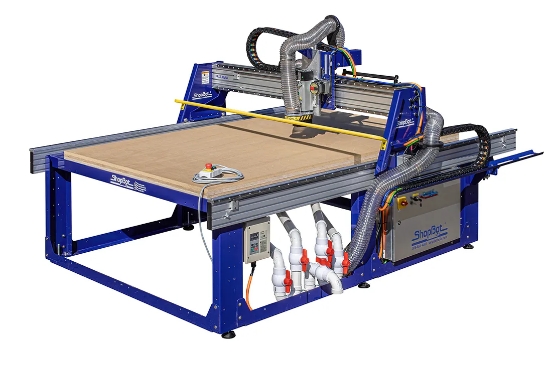
Working Surface: 4 x 4 feet
Maximum Cutting Rate: 720 inches per minute
Maximum Travel Rate: 1800 inches per minute
Positional Resolution: 0.0004"
Collet Sizes: 1/4" or 1/2"
Compatible Materials: Polymers, Aluminum, Wood
Units: 1
Location(s): Davis
Unique Properties:
- Large working envelope
Shaper Origin

Working Surface (X-Y): Infinite
Quill Travel (Z-working distance): 1.7 inches
Motor Power: 720 Watt
Spindle Drive: Variable from 10,000 to 26,000 RPM
Maximum Travel Rate: 100 IPM
Tool Holding: 1/4" Collet
Units: 1
Location(s): Davis
Unique Properties:
- CNC-assisted machining compatible with Steels, Stainless Steels, Aluminum, Plastics, More.
- CNC-assisted manual router affords precision, portability, and scale in one unique package
- Uses Vision system paired with markers for live tracking in 3D space
HAAS UMC 500 - 5 Axis CNC Mill

Working Surface (X / Y / Z): 24" × 16" × 16" (610 × 406 × 406 mm)
Max Spindle Speed: 8,100 RPM
Spindle Taper: 40-Taper
Rotary Axes: B-axis (trunnion, ±110°) and C-axis (360° continuous), cycloidal drive
Tool Changer: 30+1 side-mount tool changer
Max Table Load: 300 lbs (136 kg)
Compatible Materials: Steels, Stainless Steels, Aluminum, Titanium, Plastics, and more
Units: 1
Location(s): Aggie Square (Sacramento)
Unique Properties:
- Full simultaneous 5-axis machining — machine complex, multi-sided parts in a single setup, eliminating repositioning error and reducing production time
- Cycloidal B and C rotary drives provide exceptional rigidity, accuracy, and crash resistance
- Wireless Intuitive Probing System (WIPS) for on-machine part location and in-process inspection
Wazer Pro - CNC Waterjet Cutter

Cutting Area: 12" × 18" (305 × 457 mm)
Max Cutting Thickness — Aluminum: 1" (25.4 mm)
Max Cutting Thickness — Steel: 3/8" (9.5 mm)
Hydraulic Power: 2.1 kW
Continuous Run Time: 90 minutes
Abrasive: 80-mesh alluvial garnet
Compatible Materials: Metals, Glass, Stone, Tile, Plastics, Composites, Rubber, Foam, Wood, and more
File Formats: .SVG, .DXF
Units: 1
Location(s): Aggie Square (Sacramento)
Unique Properties:
- Cold-cutting process — no heat-affected zone, no warping; suitable for heat-sensitive materials that cannot be laser or plasma cut
- Cuts virtually any rigid material without tool changes or material-specific tooling
- Absolute-zero locating enables precise feature cutting on pre-existing parts and repeatable fixturing
Langmuir Titan 25T - CNC Press Brake
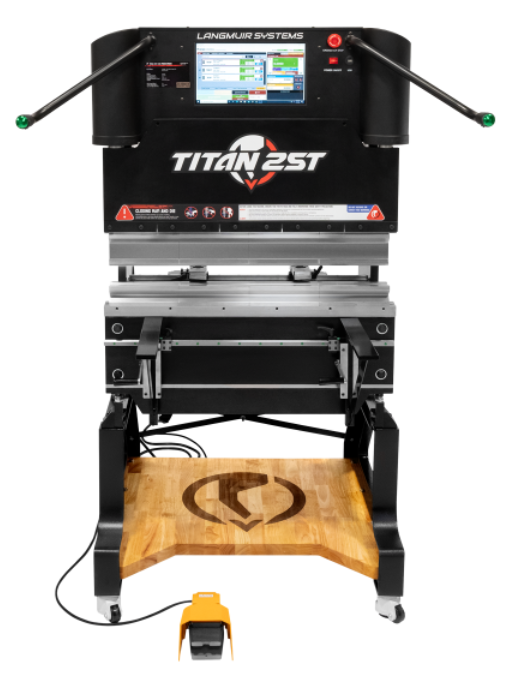
Tonnage Capacity: 25 Tons
Max Bend Width: 33" (838 mm)
Ram Travel: 4"
Max Hydraulic Pressure: 3,000 PSI
Positional Accuracy: ±0.0002"
Tooling Standard: American-style punches and dies
Control: BendControl — onboard LCD touchscreen, conversational programming; no external software required
Compatible Materials: Steel, Stainless Steel, Aluminum sheet and plate
Units: 1
Location(s): Aggie Square (Sacramento)
Unique Properties:
- Dual hydraulic rams synchronized via AC servo motors and glass scale encoders — maintains ±0.0002" positional accuracy even under asymmetrical loads
- BendControl conversational programming allows single bends and multi-bend sequences to be programmed directly at the machine without external software
- Optional 2-axis CNC backgauge for precise and repeatable material positioning across production runs
HAAS SR-3015 — CNC Sheet Router

X / Y / Z Travel: 118" × 59" × 7.1" — accommodates full 5' × 10' sheets
Spindle Speed: 18,000 RPM (ER32 collet, up to 0.75" tool diameter)
Spindle Power: 10 HP
Tool Changer: 8-station linear tool changer
Table: PVC vacuum table with selectable zones and 7.4 HP vacuum pump
Control: Full-function Haas CNC control
Compatible Materials: Wood, Plastics, High-Density Foam, Composites, and other non-metallic sheet materials
Units: 1
Location(s): Aggie Square (Sacramento)
Unique Properties:
- Full-sheet capacity — accommodates 4' × 8' or 5' × 10' sheet stock, long extrusions, or multiple setups in a single fixturing
- Vacuum table with selectable zones provides secure, flexible workholding for flat sheet materials without clamps
- Full Haas CNC control — same familiar interface as our UMC-500
Kent KTM-3VKF — CNC Gantry Mill

Table Size: 10" × 54"
X-Axis Travel: 32"
Y-Axis Travel: 14"
Knee Travel: 16"
Quill Travel: 5"
Spindle Speed: 80 – 4,500 RPM
Spindle Taper: R-8
Motor Power: 3 HP (AC-Frequency drive)
Control: Acu-Rite MillPWR G2 — conversational CNC, full DRO mode, G-code and DXF import
Compatible Materials: Steels, Stainless Steels, Aluminum, Plastics, and more
Units: 1
Location(s): Aggie Square (Sacramento)
Unique Properties:
- MillPWR G2 control seamlessly switches between full manual DRO operation and CNC mode — ideal for setup work, one-off parts, and fixturing
- Accepts G-code from CAD/CAM software and DXF files directly for full 3D contoured parts from digital designs
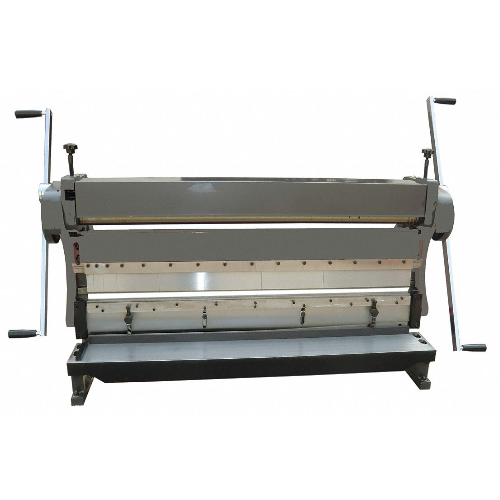
Other Metalworking and Machining Equipment




Materials
Metals:
Aluminum: Popular for its lightweight, high machinability, and good thermal properties. Commonly used in aerospace, automotive, and consumer goods.
Steel: Available in many grades, from mild steel to tool steel. It's valued for its strength, versatility, and heat treatability.
Stainless Steel: Corrosion-resistant and used for applications needing high strength and durability, like medical devices and food processing.
Brass: Known for excellent machinability, it’s used in fittings, valves, and precision instruments.
Copper: Valued for its electrical conductivity, often machined for electronic components.
Non-Metals
Acrylic (PMMA): Easy to machine, used in optical applications due to its clarity.
Nylon: Used in industrial applications for its toughness and wear resistance.
Delrin (POM): Common for parts requiring high stiffness, low friction, and good dimensional stability.
PTFE (Teflon): Low friction and chemical resistance make it useful for seals and gaskets.
Polycarbonate: Tough and impact-resistant, used where transparency and strength are needed.
Examples
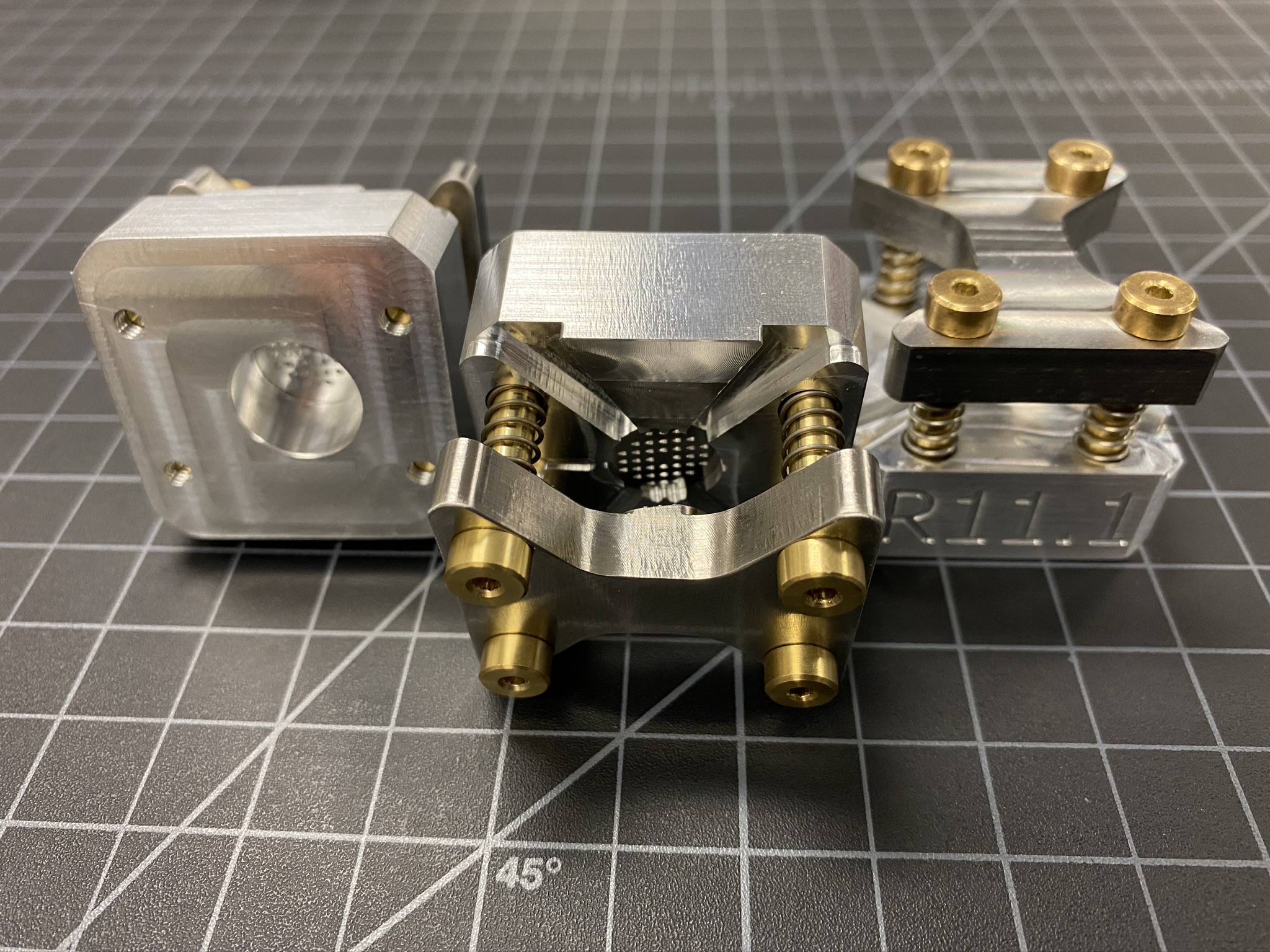


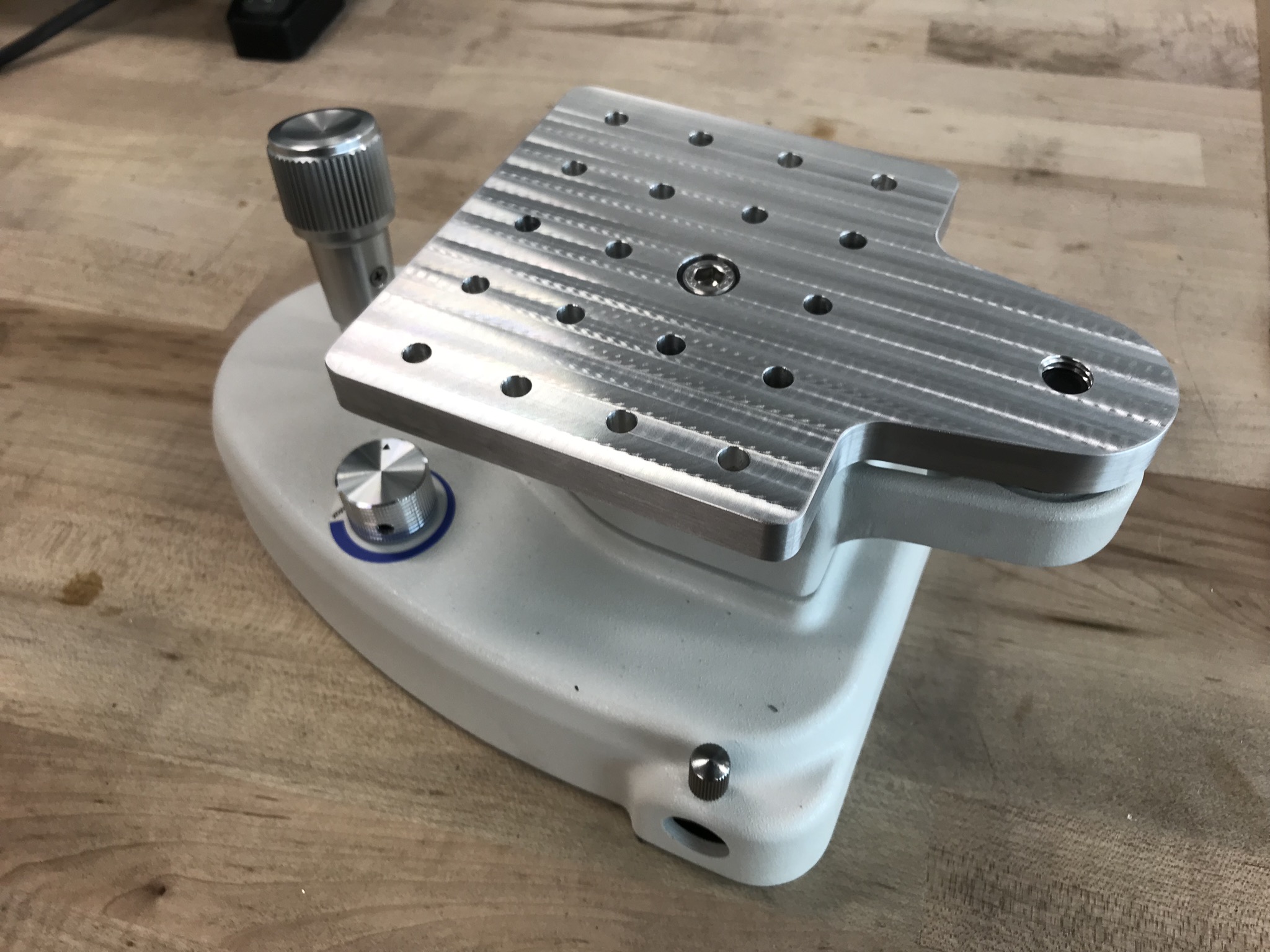
Machining Gallery
Click here to view more example machined parts
Rates
- Note: We strongly recommend submitting a service request to obtain an accurate project cost estimate. Self-quoting can often lead to miscalculations
We bill for time and materials while using our equipment. For time, we assess staff time and machine time at different rates. We bill to the nearest quarter hour, with a 1 hour minimum.
| Description | Internal | External | |
| Materials & Supplies | Reimburse at-cost, we order on your behalf | At-Cost | At-Cost+NUD* |
| Setup and Processing | Staff use | $119/hour | $160/hour |
| Hourly Use Rate | Expense per hour of machine use | $25/hour | $33/hour |
*NUD = university required "Non-University Differential"
Estimating project cost should be left to Tech Foundry, but here are some general project estimates that can guide in self-estimating:
| Relative Project Magnitude | Cost for First Unit, Typical Range | Cost for Additional Units, Typical Range |
| Small | $100-$150 | $10-30 |
| Medium | $150-$350 | $30-$100 |
| Large | $350-$750 | $100-$300 |
| Extra Large | $750+ | $300+ |
*All declared values at internal rates, NUD = university required "Non-University Differential" added for external.
Optional Post Processing Services
Hole Tapping
Hole tapping is a machining process used to create internal threads in a pre-drilled hole so that fasteners, such as bolts or screws, can be inserted. It involves using a tool called a tap, which has cutting edges that match the desired thread profile. The tap is inserted into the hole, and as it rotates, it cuts or forms threads into the material. Tapping can be performed manually or using a machine like a tapping head on a drill press or CNC machine.
Polishing
Polishing is a finishing process used to enhance the surface quality of parts in an effort to achieve a smooth, glossy finish. It involves using fine abrasives, which can be applied manually or by machine, to remove fine scratches or imperfections on the surface. Polishing is often the final step in the production process, used to create parts with a low surface roughness. .
Vibratory Finishing
Vibratory finishing is a manufacturing process used to improve the surface quality of parts by removing burrs, smoothing rough surfaces, or polishing. In this process, parts are placed in a vibratory tub or bowl along with abrasive media, compounds, and water. The machine vibrates, causing the abrasive media to scrub against the surfaces of the parts, achieving a uniform finish. It is commonly used for deburring, edge radiusing, surface smoothing, and polishing a wide range of materials, including metals and plastics, particularly for parts with intricate shapes that would be difficult to finish manually.
Preparing Files for Manufacturing:
You are welcome to furnish dimensioned drawings and/or a parametric CAD model of your intended geometry. Between a dimensioned drawing, or a parametric model (Solidworks, Inventor, STEP), we prefer the parametric model as it is directly compatible with our CAM (Computer Aided Machining) software. We can also help you realize this input file via our design services.
Technical Details
CNC (Computer Numerical Control) machining represents an advanced manufacturing process characterized by the use of computer-controlled tools to precisely remove material from a workpiece, thereby creating complex geometries or functional components. The process hinges on the precise execution of G-code or M-code instructions, which are programmed to govern the movements of machine tools such as lathes, mills, routers, and grinders, ensuring high precision and repeatability. CNC machining is versatile in terms of material compatibility, encompassing metals, polymers, wood, and composite materials, and is capable of producing intricate parts with tight tolerances, making it applicable across industries including aerospace, automotive, and medical device manufacturing.
The primary strength of CNC machining lies in its capacity for exceptional accuracy and precision. The high level of automation inherent in CNC systems mitigates the risk of human error and facilitates consistent production quality. Furthermore, CNC machining excels in generating intricate geometries that are impractical or unachievable through manual machining methods.
Despite its strengths, CNC machining presents several limitations. The initial investment is substantial, encompassing the costs associated with programming, tooling, and calibration, which can render it less economically viable for low-volume production when compared to additive manufacturing alternatives such as 3D printing. The inherently subtractive nature of CNC machining often results in significant material waste, particularly with high-value materials, which may necessitate cost and waste mitigation strategies. Additionally, the process's mechanical forces impose constraints on the machining of delicate or flexible materials, as these forces may induce deformation or damage to the workpiece, limiting its application in such contexts.
In summary, CNC machining is a formidable technology for the production of parts demanding high precision and efficiency, especially when addressing complex geometries and tight tolerances. Although the technology entails considerable initial costs and generates material waste, its precision, repeatability, and suitability for medium to high production volumes underscore its vital role in modern manufacturing, where stringent quality standards are non-negotiable.
General Design Guidelines for CNC Machining:
- Material Selection: Choose materials with good machinability to reduce tool wear and improve surface finish. Metals like aluminum and brass are easier to machine compared to harder alloys.
- Minimize Deep Cavities: Design with shallow cavities when possible. Deep cavities require specialized tools and longer machining times, increasing cost and complexity.
- Avoid Thin Walls: Maintain a minimum wall thickness to prevent deformation under cutting forces. Thin walls can vibrate or bend, compromising part accuracy.
- Standardize Hole Sizes: Use standard drill sizes for holes to simplify tooling and minimize the need for specialized cutters.
- Fillet Radii in Internal Corners: Add appropriate fillet radii to internal corners to accommodate the round geometry of cutting tools
- Limit Tight Tolerances: Apply tight tolerances only where necessary, as tighter tolerances increase machining time and cost. Use standard tolerances for non-critical dimensions.
- Design for Fixture Accessibility: Ensure that part geometries allow for easy clamping and fixturing to prevent unnecessary setup difficulties and ensure stable machining.
- Consider Machine Capabilities: Be aware of the limitations of the CNC machine being used, such as axis limits, spindle speed, and tool size, to ensure the design is practical for production.
Get Started
- Heard enough? Get started with a service request! Your request need-not be perfect, we can always revise it as we go. Just provide us with as much detail as is necessary.
- Feeling overwhelmed with the options? We don't blame you! We do a lot! Feel free to email us to set up a consultation. We're happy to chat via zoom, or in person (where we can review samples).